Allied liberation of Paris
Across the River and into the TreesThe Allied liberation of Paris emerges in Richard Cantwell’s account as both a celebrated historical event and a deliberately difficult story to simplify. He participated in the advance, but resists treating the city’s liberation as a single triumphant operation: French forces had entered Paris four days earlier, Allied command arrangements slowed his movement, and the fighting he considered worth describing was concentrated outside the city. Recounted to a woman who asks whether the event was noble or happy, his version turns military history into an argument about the distance between public ceremony and the complicated work of soldiers.
Background and Command Plan
Cantwell begins by denying the liberation the status of a great military operation. In his telling, the taking of Paris was primarily an emotional experience. The city mattered, but the capture itself did not match the scale of its reputation. He recalls fatalities among typists and a German covering force left during the withdrawal, presenting these as part of the costly but unglamorous circumstances of the advance rather than as evidence of a decisive battle inside Paris.
The Allied plan further unsettled the idea of a clean, singular liberation. Cantwell says the French had taken the city four days earlier, while the Supreme Headquarters of the Allied Expeditionary Forces had devised an encompassing plan and therefore would not simply move in and take it. The plan’s language of envelopment and command stood in contrast to the straightforward image of a city being liberated by a single force. Cantwell also mocks the expectation that Bernard Law Montgomery might arrive in time: in his assessment, Montgomery had not even closed the Falaise Gap and could not reach Paris on schedule. The delay is part of Cantwell’s larger point that military events are shaped not only by what happens on the ground but by plans and senior officers who may not arrive when anticipated.
His account also complicates any assumption that the whole advance began at the city limits. Cantwell says his force fought twelve times between Rambouillet and Paris, although only the actions at Toussus le Noble and Le Buc qualified, in his judgment, as real fights. The rest was necessary preparation, not a sequence of equally significant battles. This distinction gives the liberation a long approach but a sharply selective memory: many encounters occurred, yet only two survive in his account as substantial fighting.
The Advance into Paris
Cantwell describes the division of routes after his force separated from Leclerc’s column at Clamart. Leclerc’s men continued toward Montrouge and the Porte d’Orleans; Cantwell’s force went directly to Bas Meudon and secured the bridge at the Porte de Saint Cloud. After taking the bridge, his men established a bridgehead across the river. The Germans defending it were thrown into the Seine, an act Cantwell calls the result of a token defence and says the defenders were mostly office workers. He presents that identification as his belief, not as a verified account of every German at the bridge.
The following morning, reports described German strongpoints, artillery on Mount Valerien, and tanks roaming the streets. Cantwell says some of this information was true. The reports and the request not to enter too quickly placed his force in an unusual position: it was advancing toward the city while being asked to leave the taking of Paris to Leclerc. Cantwell says he complied and entered as slowly as he could. His explanation is pointedly practical. The delay amounted to holding the attack for two hours, while accepting champagne offered by patriots, collaborators, or enthusiastic residents. The detail gives the pause an almost festive surface, but it remains tied to a military instruction and a managed pace of advance.
He does not claim that the city was entered without any fighting. Asked whether his men had to fight, he says they did so three times, but not seriously. Elsewhere, he describes fighting through Bas Meudon and the Porte de Saint Cloud and proceeding along streets he knew and loved, with no deaths among his own force and as little damage as possible. These statements qualify rather than erase the violence of the operation: the advance involved armed resistance and fatalities, but Cantwell distinguishes its limited intensity in the city from the fighting on the route in. His emphasis is on the scale and character of combat, not on an uncomplicated story of a bloodless entry.
Incidents, Celebration, and Contradiction
At the Etoile, Cantwell’s force took Elsa Maxwell’s butler prisoner. The arrest followed an accusation that the man was a Japanese sniper responsible for the deaths of several Parisians. Cantwell says three men were sent to the roof where the butler had taken refuge, and identifies him as an Indo-China boy. In a story crowded with plans and routes, this incident makes the instability of wartime information concrete: an accusation framed the man as a sniper, but the person Cantwell says his soldiers found did not fit that description. His account gives no further outcome for the prisoner, so the episode remains a brief instance of suspicion and mistaken identification within the advance.
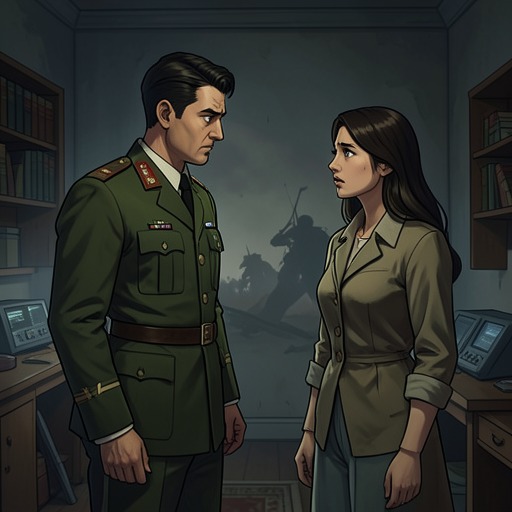
The public appearance of liberation is also present in Cantwell’s recollection, but he treats it as something distinct from military achievement. Leclerc’s men fired many rounds, he says, to make the event seem important and because his own force had supplied them with ammunition. Cantwell even recalls celebrating Leclerc’s death with a magnum of Perrier-Jouet Brut 1942. The juxtaposition is deliberately unsentimental: the celebratory noise around Paris does not persuade him that the capture was militarily decisive. Yet his account is not simply dismissive. When asked whether there was anything noble or truly happy, he affirms that there was. The city itself mattered; its people were happy, and old general officers walked about in mothballed uniforms. His own force was happy not to have to fight. Relief, civic celebration, and military skepticism coexist rather than cancel one another.
Recollection and Significance
The event reaches the reader as a spoken recollection shaped by a listener’s questions. The woman asks whether the taking of Paris was a great thing, whether Cantwell took part, whether it left a strong impression, and whether it contained anything wonderful. Her questions repeatedly invite the familiar heroic account; his replies separate participation from admiration and emotional importance from military scale. At one point Cantwell says he can insert anecdotes to make the story interesting or plausible. That admission makes the form of his recollection part of the event’s meaning: he is not presenting an impersonal campaign history, but a soldier’s account that openly acknowledges its own construction.
The resulting portrait is neither a denial of Paris’s importance nor a simple celebration of victory. Cantwell remembers an advance governed by a broad Allied plan, the prior entry of French forces, delayed movement, scattered engagements, and a careful attempt to limit damage. He also remembers the city’s happiness and his own relief at not having to fight there. The contrast between these details challenges the idea that a famous liberation must have been one clear, uniformly noble battle. In Cantwell’s telling, the event’s emotional force lies partly in the city and its people, while its military reality is uneven, contingent, and less grand than its public image.